Container Cost Optimization
Container Cost Optimization: A Strategic Guide for Technology Leadership
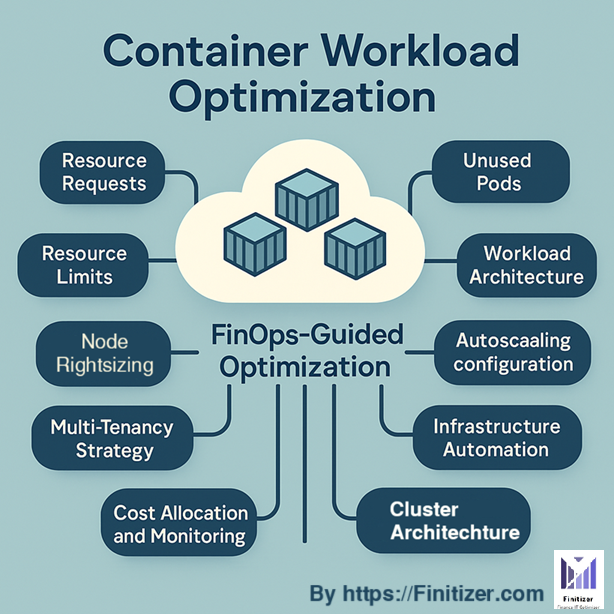
Cloud-native containerization through Google Kubernetes Engine (GKE), Amazon Elastic Kubernetes Service (EKS), and Azure Kubernetes Service (AKS) has revolutionized application deployment. However, without systematic optimization, these platforms become significant cost centers. This guide outlines ten critical optimization areas that can deliver 40-70% cost reductions while maintaining performance and reliability.
The Business Case for Container Optimization
Organizations running containerized workloads at scale face exponential cost challenges. With environments supporting hundreds of thousands of pods across multiple clusters, modest inefficiencies translate to millions in unnecessary spending. Industry data demonstrates that systematic container optimization delivers substantial returns without compromising operational performance.
According to State of Finops 2025 Report
“ Workload optimization and waste reduction is the top priority by a clear margin for FinOps practitioners. Optimization was also a top priority for 2024 and has remained a priority for 50% of practitioner respondents”

Ten Critical Optimization Areas
| Optimization Area | Business Impact | Expected Savings |
|---|---|---|
| Resource Requests | Over-provisioned CPU/memory consuming unnecessary infrastructure | 20-50% |
| Resource Limits | Performance unpredictability and capacity planning challenges | 10-30% |
| Unused Pods | Ghost workloads without business ownership | 15-40% |
| Node Rightsizing | Mismatched infrastructure creating bin-packing inefficiencies | 15-35% |
| Cluster Architecture | Excessive clusters with poor namespace utilization | 20-45% |
| Workload Architecture | Monolithic applications requiring oversized infrastructure | 25-60% |
| Infrastructure Automation | Manual resource management without intelligent policies | 30-70% |
| Autoscaling Configuration | Poorly tuned scaling creating resource waste | 20-50% |
| Multi-tenancy Strategy | Poor resource isolation complicating cost management | 15-35% |
| Cost Monitoring | Limited visibility preventing optimization identification | 10-25% |
Strategic Implementation Framework
Phase 1: Foundation (10-30% Savings)
Establish comprehensive monitoring, implement cost allocation through strategic labeling, and create governance policies for resource management. Focus on quick wins through basic rightsizing and unused resource elimination.
Phase 2: Optimization (30-60% Savings)
Deploy automated resource optimization, implement policy enforcement, and establish team training programs. Address over-provisioning through Vertical Pod Autoscaler (VPA) implementation and systematic load testing.
Phase 3: Advanced Strategies (60%+ Savings)
Implement advanced autoscaling, optimize cluster architecture, and integrate interruptible compute resources offering up to 91% cost savings for appropriate workloads. Deploy AI-powered optimization tools for continuous improvement.
Key Technical Priorities
Resource Management
Over-provisioning represents the largest optimization opportunity. Address this through VPA implementation, systematic load testing, and AI-powered rightsizing tools that analyze historical usage patterns. Implement strategic memory limits while avoiding CPU limits in production environments.
Ghost Workload Elimination
Unused pods consume infrastructure without delivering business value. Implement comprehensive labeling policies enforced through admission controllers, with automated cleanup of persistently unlabeled resources.
Cluster Consolidation
Cluster sprawl creates unnecessary operational overhead. Consolidate through namespace-based multi-tenancy, comprehensive resource quotas, and role-based access control. This delivers reduced control plane costs and improved resource utilization.
Intelligent Automation
Deploy policy-driven infrastructure automation including scheduled shutdown for non-production environments, automated cleanup of ephemeral resources, and on-demand provisioning that responds to business demand patterns.
Executive Action Items
Immediate Priorities:
- Establish virtual but dedicated optimization teams with clear accountability
- Integrate cost optimization metrics into business performance indicators
- Invest in comprehensive monitoring and automation tools
- Create organizational incentives rewarding efficient resource utilization
Cultural Transformation:
- Establish cost awareness throughout development teams
- Implement optimization-friendly development practices
- Create accountability mechanisms for resource consumption
- Maintain focus on business value alignment
ROI and Business Impact
Container optimization initiatives deliver measurable business value through:
- Immediate cost reductions of 20-50% through basic rightsizing
- Sustained savings of 60% or more as practices mature
- Improved application performance and operational efficiency
- Enhanced competitive advantage through efficient infrastructure utilization
The investment typically pays for itself within months while creating sustainable operational advantages.
Conclusion
Container optimization represents one of the most significant cost reduction opportunities in modern cloud environments. Success requires treating optimization as a strategic business initiative rather than a purely technical exercise.
Organizations that master container optimization gain significant competitive advantages through more efficient infrastructure utilization, faster application deployment, and better alignment between technology investments and business outcomes. The ten optimization areas provide a clear roadmap for achieving these benefits while building organizational capabilities for sustained improvement.
The path forward requires executive commitment, proper tooling investment, and organizational changes that make efficient resource utilization a core competency. Begin with assessment and quick wins, then systematically progress through advanced optimization techniques while building the capabilities necessary for long-term success.
Finitizer Assessment: Unlocking Container Cost Efficiency
Finitizer provides a comprehensive assessment of your current container infrastructure, delivering the actionable insights senior technology leaders need to drive cost optimization. Leveraging deep analytics across all major cloud platforms, Finitizer evaluates critical factors, including resource utilization, workload distribution, cluster sizing, and scaling effectiveness, to identify specific areas of inefficiency.
Through this assessment, Finitizer pinpoints overprovisioned clusters, underutilized nodes, and suboptimal autoscaling configurations, directly aligning with the ten optimization areas outlined in this guide. The result is a clear, prioritized roadmap for reducing container costs, often by 50% or more, while safeguarding application performance and scalability.
By partnering with Finitizer, organizations gain the visibility and strategic direction required to transform container operations into a source of sustained business value.